
Programming… the backbone of the 21st century’s information revolution? Some might even go as far as to point out that programming will be the new literature, the future, quite possibly. Not so fast! Not even close! Today we’re looking back to find the main contributing factor for the information revolution and the rise of artificial intelligence we’ve seen recently and how it all relates to programming.
What is programming?
Firstly, we have to define what programming even is. According to Wikipedia, programming is the process of designing and building an executable computer program to accomplish a specific computing result, simply put, programming is the process of telling a computer what to do.
But that doesn’t really mean anything to a layperson. The phrase “telling a computer what to do” is a very vague one, since everything nowadays revolves around some level of reliance on computing. Instead, let’s take a look at a programming-related job and see how it differs from the literal term “programming”.
Software development is divided into 2 big parts. The first part, nicknamed the “programming” part is just about that, programming, this is the “telling a computer what to do” part. The second part, however, is the part of software development that most people overlook. This part has nothing to do with programming, rather, it mostly revolves around analyzing problems and finding a way to solve them with the power of computers.
Before we could continue on with the article, just understand that programming is only a tool, a skillset, one that allows you to turn ideas into a usable solution for many to use. There can’t be a solution if there is no problem, and there can’t be a solution if one doesn’t know how to solve a problem, just like how a hammer is useless without a nail. A programmer needs to know both how to use the tool and how to apply it to solve problems.
Programming on its own is useless without the knowledge of other fields. This is why companies need people to work in teams, it’s because people specialize in different fields, one might be good at programming while the other at marketing.
Modern programming
Programming trends have seen a lot of shifts during the past few decades. One of the most important is the shift from starting from scratch to starting with easy-to-use templates, services, and tools that help make programming consume less time so that it can be spent on more critical sectors.
And programming is only going to get easier for developers. If you thought programming is a valuable skill in 2020, you’re 20 years late, all major software companies don’t hire employees solely on programming anymore. Programming is no longer a valuable skill because modern tools make it easy for even a novice developer to come up with a program quickly and with ease.
Critical thinking is one of the most important aspects of programming. It allows developers to reduce the time spent on coding with the compromise of having to think about how the program should be laid out and how it can be implemented in the most efficient way possible.
Modern programming is not about writing code, it’s about finding the application for programming and applying it with pre-written code that does the hard work. Think of it this way, suppose you want to cook up some food, you would gather ingredients and start cooking, the process of combining ingredients to make your plate is the same as combining different services and templates in programming.
You don’t have to go out of your way to plant cane to make sugar, or grow and harvest your own crops for rice. All you need to know is how to combine already pre-made ingredients to create your meal—that’s modern programming. Modern tools embrace modern programming with features that help developers to come up with programs and integrate code from different sources even faster.
AI, Machine Learning, Deep Learning, Big data
Buzzwords that all relate to programming in one way or another. All exist because of researchers, who are not in any way experienced in programming. This is possible thanks to modern programming languages that require little time to memorize, understand, and write programs with. Since computers can process data faster than any human can, researchers can quickly take advantage of them to accelerate their research or share them to make them publicly available.
Traditional software developers can then take advantage of those pre-written and publicly available code implementations of advanced mathematical or scientific theories and use them to solve problems, now with AI and Machine Learning and whatnot.
Let’s go back to the cooking example, now, instead of cooking for yourself, you cook for the people who are under the poverty line, and instead of using ingredients made by low-skilled farmers you use ingredients that are made by low-skilled farmers that are quality-controlled and packaged by food scientists, ingredients that have more nutritional value and lower production costs, I know food scientists don’t do that, but bear with me here. You would ultimately end up creating better meals because you can do more with better ingredients. That’s the status quo of programming and AI. And this doesn’t just apply to AI research, most third-party services and tools are backed up by large tech companies and active communities.
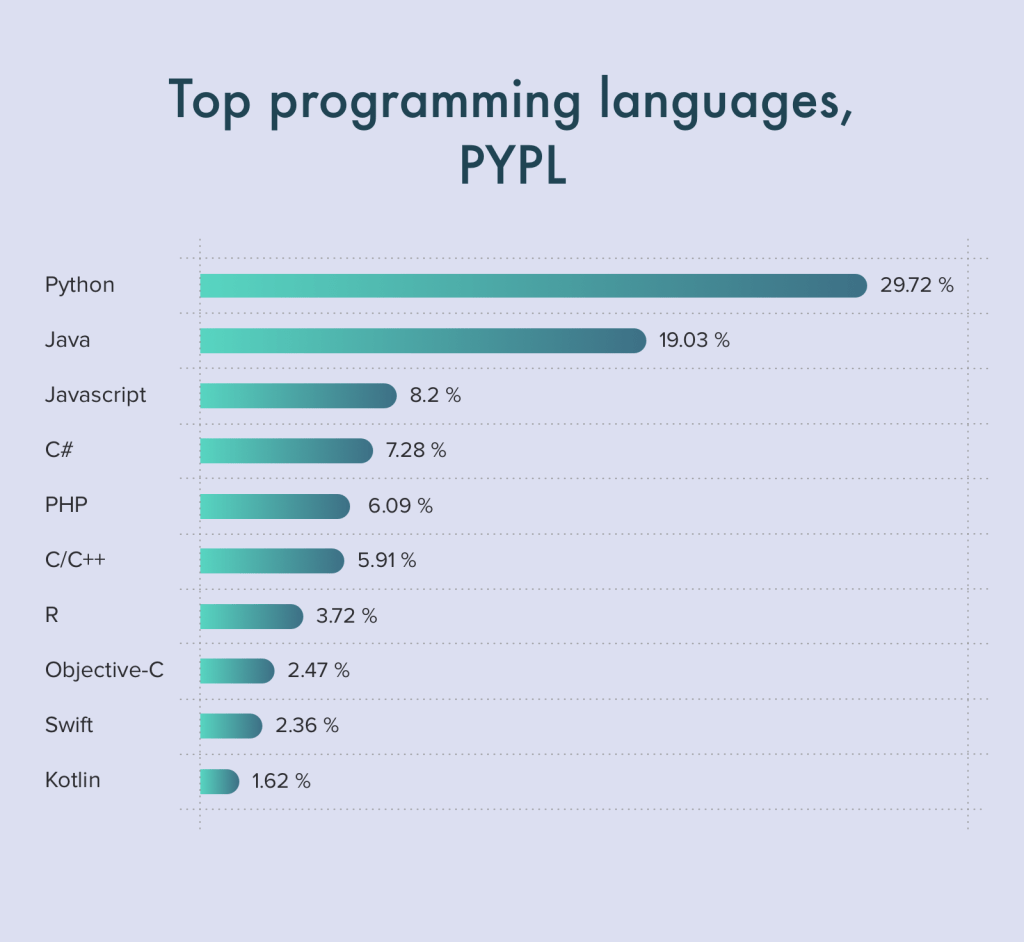
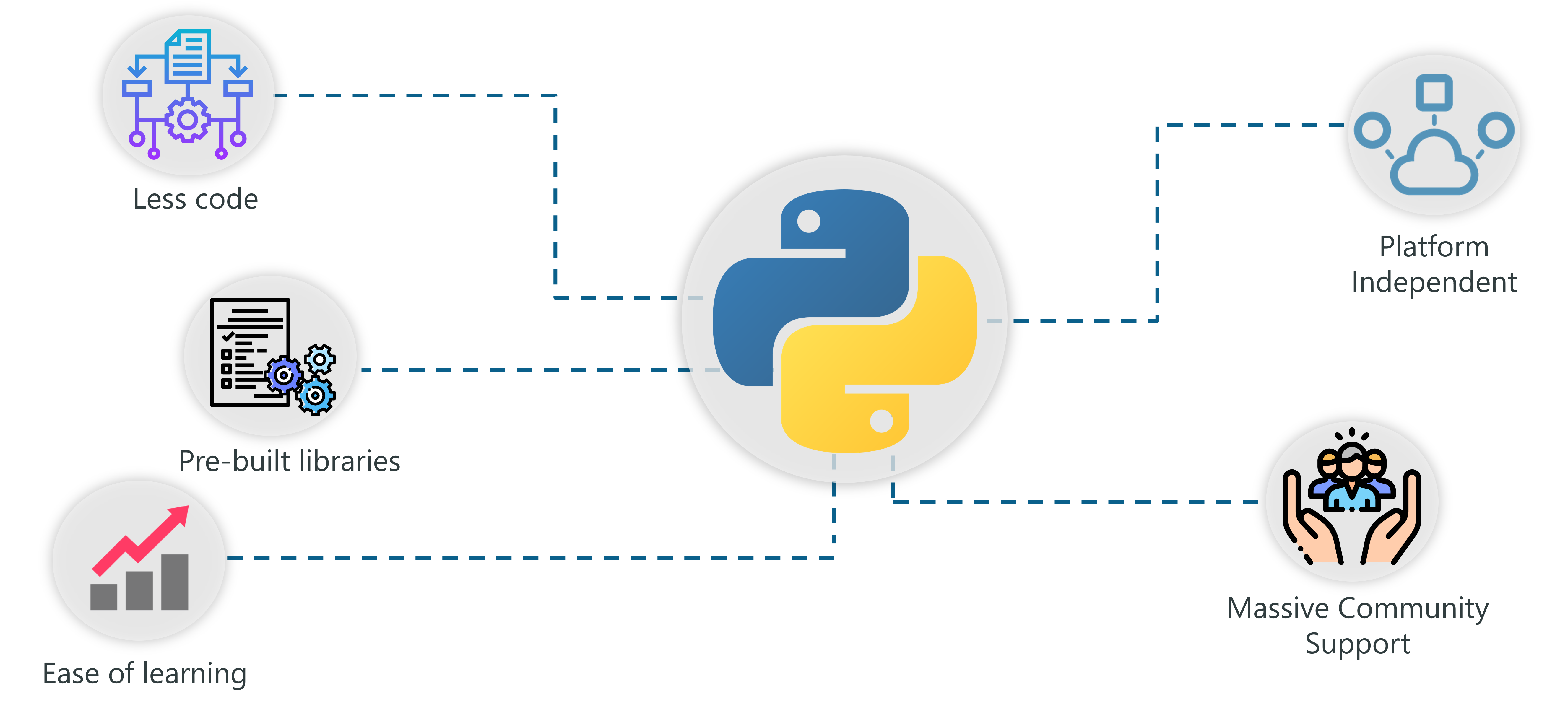
One great example of this is Python, a programming language known for being slow compared to other languages. Despite having the word “slow” in its description its use is limited only by the programmers themselves. Numerous libraries are made by incredibly bright researchers that have a deep understanding of maths and science. This is all possible because of Python’s beginner-friendliness that allows ordinary researchers or anyone to quickly pick up and use for their own good. Mind you, those people are not at all programmers, but people who specialize in other fields.
The future of programming
So then, what does that all lead up to? First, ease of use is more important than speed. The easier it is for a programming language to be understood, the better. Second, libraries, wrappers, and support: people don’t want to use a programming language if they have to reinvent the wheel multiple times when the only thing they want to do is build something the quick and easy way, especially if there is no one who is qualified to help them if they ever run into a problem. Third, bleeding-edge features, which are features that are new, though unstable, are more of an appealing feature than maturity and stability. Stability doesn’t matter as much when the code works most of the time and with more features than the more stable solution.
Putting the pieces together, you get an easy-to-use, beginner-friendly programming language with a big community and a large set of pre-written libraries that are easy to combine to create something new. That’s Python and the reason why it rules when it comes to AI, Data science, and IoT integrations.
A new universal programming language would emerge that meets all of the criteria and follows them better than Python.
Why it isn’t the future
Programming won’t define the future. Instead, the future will be those things built with programming with the help of bright people who know about other fields well. When we think about the future, we think AI and Augmented reality, and all are possible because of math, science, and programming.
You must understand that programming is the implementation of the mathematical and scientific theories that make those innovations possible. Programming in and of itself is nothing but telling computers what to do. Programmers will be gone; the world doesn’t need mere translators for machines. It needs people who know math, science, marketing, and problem-solving. We have built a platform for those kinds of people to emerge in the near future—people who can and will create new and innovative things for the later generation to then take advantage of and build new things with. It’s a cycle of generations coming up with new tools and the later generation taking advantage of them.
Programming might not even exist in the near future. In fact, AI is used in every aspect of programming these days, ranging from tools that help to make codes easier to navigate through to fully-automatic code generation.
Don’t be afraid to code, be afraid of coming up with solutions no one needs
You should program; it teaches you more than just how to code. What you shouldn’t do is think that just because you know how to program that you can easily get a 6-figure job. Programmers do more than just programming. The future will turn against you if you have that mindset. Get into math, get into science, learn to work in teams, build things the world needs. And most importantly, learn critical thinking and problem-solving skills– these allow you to solve the problems using coding as another tool in your tool belt.
Programming is a fundamental basis of every significant innovation, yet its significance and importance are going down a steady decline as it becomes easier to use by more and more businesses and professionals of other fields, to integrate it as a part of their workflow to create easily accessible tools and products for the world to use.
Every innovation starts with a problem, problems turn into ideas and ideas turn into implementations. Implementation is the least significant step of the 3, but without it, no one except you will be able to use your solution. Programming is the implementation step. It’s a tool that will make the solution a reality, but it wasn’t the innovator.
Personal view: Why I program

This section deserves its own article, and I’m not going to go deep into it.
Technology, for me, has always been about the consumer. And it shows, technology focuses too much on the consumer and this leads to them being spoiled. People don’t know what’s happening behind the scenes and don’t have control over the companies and the products they use, nor do they want to. This is the real reason why I encourage people and myself to program, it’s because I want them to have at least some level of understanding of what’s going on when they’re on their phones or computers so that they won’t get exploited and have the power to decide. That’s right, curiosity and will are what drove me into programming.
Unfortunately, as all good things are, they must come to an end, and I have answered the initial question of why programming isn’t the future, and maybe gave you a little insight into the programming world and how it isn’t all magical. Hopefully, this blog inspired you to try out programming yourself and begin your journey as an innovator… or not.
 The Bloggest